
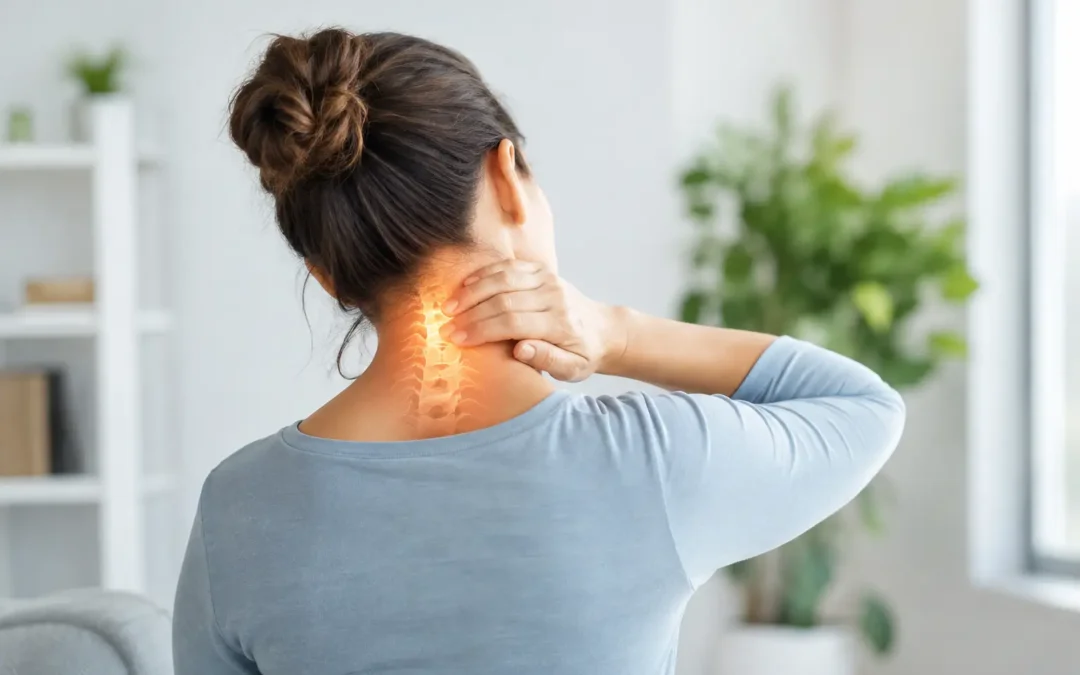
A burning line of pain from the neck into the shoulder blade or arm can make ordinary tasks unexpectedly difficult. Reaching for a seat belt, looking over your shoulder while driving, typing at work, or sleeping in one position may trigger pain, tingling, or weakness. This guide to cervical radiculopathy explains what may be happening, why a structured evaluation matters, and how active, non-surgical rehabilitation can support recovery.
Cervical radiculopathy is not simply a sore neck. It involves irritation or compression of a nerve root in the cervical spine, the seven vertebrae of the neck. Because those nerve roots travel into the shoulder, arm, and hand, symptoms can be felt well beyond the original source.
What Cervical Radiculopathy Feels Like
People experience cervical radiculopathy differently. Some have sharp, electric pain that shoots from the neck down one arm. Others notice intermittent pins and needles in the fingers, a deep ache around the shoulder blade, or a hand that feels weaker when gripping a cup, turning a key, or lifting groceries.
The pattern can offer useful clues. A particular cervical nerve root supplies sensation and muscle control to specific parts of the arm and hand. For example, symptoms traveling toward the thumb can differ from symptoms felt mainly in the middle fingers or little finger. That said, symptoms do not always follow a perfect textbook map. Muscle guarding, shoulder problems, and peripheral nerve irritation can overlap, which is why an examination is more useful than trying to self-diagnose based on a single symptom.
Neck movement may aggravate symptoms, especially looking up, turning the head, or holding a forward-head position for long periods. Coughing, sneezing, driving, desk work, and lifting can also increase pressure or tension around an irritated nerve. In some cases, arm pain is more noticeable than neck pain.
Why a Cervical Nerve Root Becomes Irritated
A nerve root needs adequate space and a stable, well-functioning spinal environment. Several conditions can reduce that space or make the nerve more sensitive. A disc bulge or herniation can place pressure on a nerve root. Degenerative changes may narrow the openings where nerves leave the spine. Joint inflammation, muscle spasm, and postural strain can add to the problem.
Trauma is another common contributor. A car crash can force the head and neck through rapid acceleration and deceleration, even when the vehicle damage seems minor. Whiplash injuries may affect discs, ligaments, joints, muscles, and the normal cervical curve. Symptoms are not always immediate. Inflammation and protective muscle tightness can build over hours or days, and nerve-related symptoms may become clearer as a person returns to work or regular activity.
Long-standing posture can matter as well. Hours spent with the head carried forward while working at a computer or looking down at a phone can place added demand on the neck and upper-back muscles. Posture alone does not explain every case, and it is not a reason to blame yourself. It is one factor a provider may evaluate when building a plan for recovery and prevention.
A Guide to Cervical Radiculopathy Evaluation
The first goal is to determine whether symptoms are truly coming from the cervical spine and to identify factors that may be prolonging them. A careful clinical evaluation generally includes a health history, details about an accident or repetitive work demands, and an examination of posture, movement, reflexes, strength, and sensation.
A provider may assess which neck positions reproduce arm symptoms and whether certain positions reduce them. They may also examine the shoulder, elbow, wrist, and hand because these structures can cause symptoms that resemble a neck nerve problem. Imaging may be appropriate when there is significant trauma, progressive weakness, persistent symptoms, or concern for a disc injury or structural change. Imaging findings must be interpreted in context. Many adults have disc changes on imaging without pain, while others have meaningful symptoms with less dramatic findings.
This evaluation creates a starting point for measurable care. Rather than treating every case as identical, a rehabilitation plan should reflect the person’s symptoms, spinal alignment, tolerance for movement, work demands, and goals.
When Symptoms Need Prompt Medical Attention
Most neck and arm symptoms are not emergencies, but certain changes should be assessed promptly. Seek urgent medical care for rapidly worsening arm or hand weakness, severe loss of coordination, new difficulty walking, loss of bowel or bladder control, numbness in the groin area, fever with severe neck pain, or symptoms following significant trauma.
Chest pressure, shortness of breath, sweating, nausea, or pain that may be cardiac in origin should also be treated as an emergency. A clinician can help distinguish musculoskeletal symptoms from other causes, but it is safer not to assume that pain in the shoulder, chest, or arm is only related to the neck.
The Role of Active, Non-Surgical Rehabilitation
Many cases of cervical radiculopathy improve without surgery. The best approach depends on the cause and severity of symptoms, but passive care alone is often not enough to restore lasting function. When pain settles enough to move safely, rehabilitation should help the spine and supporting muscles tolerate daily life again.
At NW Spinal Rehabilitation Clinic, care is built around the idea that an adjustment is one part of a larger corrective process. Chiropractic adjustments may be used to address restricted spinal motion, while active rehabilitation helps patients strengthen, retrain, and support the changes made during care. This is especially relevant after whiplash, disc injury, or prolonged postural dysfunction, when the neck may have lost normal movement patterns and muscular control.
Depending on the examination, a plan may include cervical traction, specific stretching, postural training, core strengthening, neuromuscular exercises, and guided at-home work. Cervical traction is not appropriate for every person, but when clinically indicated, it may help reduce nerve irritation by gently changing the mechanical forces affecting the neck. Repetitive, properly supervised traction can be paired with exercises designed to improve tolerance for upright posture and movement.
The trade-off is that rehabilitation requires participation. A quick treatment may feel good temporarily, but durable improvement generally asks more of the patient: attending scheduled visits, completing prescribed exercises, modifying aggravating activities when needed, and gradually rebuilding capacity. The pace should be based on symptoms and objective findings, not on forcing through nerve pain.
What to Do During the Early Recovery Phase
During an acute flare, protect the irritated area without becoming completely inactive. Avoid repeatedly testing painful motions or pushing through sharp, radiating pain. At the same time, total rest for extended periods can increase stiffness and fear of movement. Gentle activity within tolerable limits is often more useful than immobilizing the neck unless a medical provider has specifically instructed otherwise.
Pay attention to positions that consistently worsen symptoms. For some people, prolonged looking down is a major trigger. For others, it is looking up, carrying a heavy bag on one shoulder, or sleeping with the neck rotated. Small practical changes can reduce irritation: position screens closer to eye level, take brief movement breaks, use a headset instead of cradling a phone, and avoid sudden overhead lifting while symptoms are active.
Medication, injections, and surgical consultation may have a role in selected cases. Severe or progressive neurological loss, persistent disabling symptoms, or a structural problem that does not respond to appropriate conservative care may require a different level of intervention. Non-surgical rehabilitation is not about delaying necessary medical care. It is about using conservative treatment thoughtfully when the clinical picture supports it.
Recovery Is More Than Pain Relief
Pain reduction is meaningful, but it should not be the only measure of progress. A stronger recovery may include turning the head comfortably while driving, sleeping through the night, returning to work without arm symptoms, restoring grip strength, and feeling confident with exercise again.
Nerve tissue can be slow to calm down. Tingling may fluctuate during recovery, and muscles that have been guarded or underused need time to regain coordination. Consistent reassessment helps determine whether the plan is working or needs to change. The goal is not to chase a perfect scan or eliminate every sensation immediately. It is to restore function, protect neurological health, and give the neck and nervous system a better foundation for the demands ahead.
If neck pain is traveling into your arm, treat it as useful information rather than something to ignore. A thorough evaluation and a patient-centered rehabilitation plan can help identify the source, guide safe activity, and move recovery forward one purposeful step at a time.