
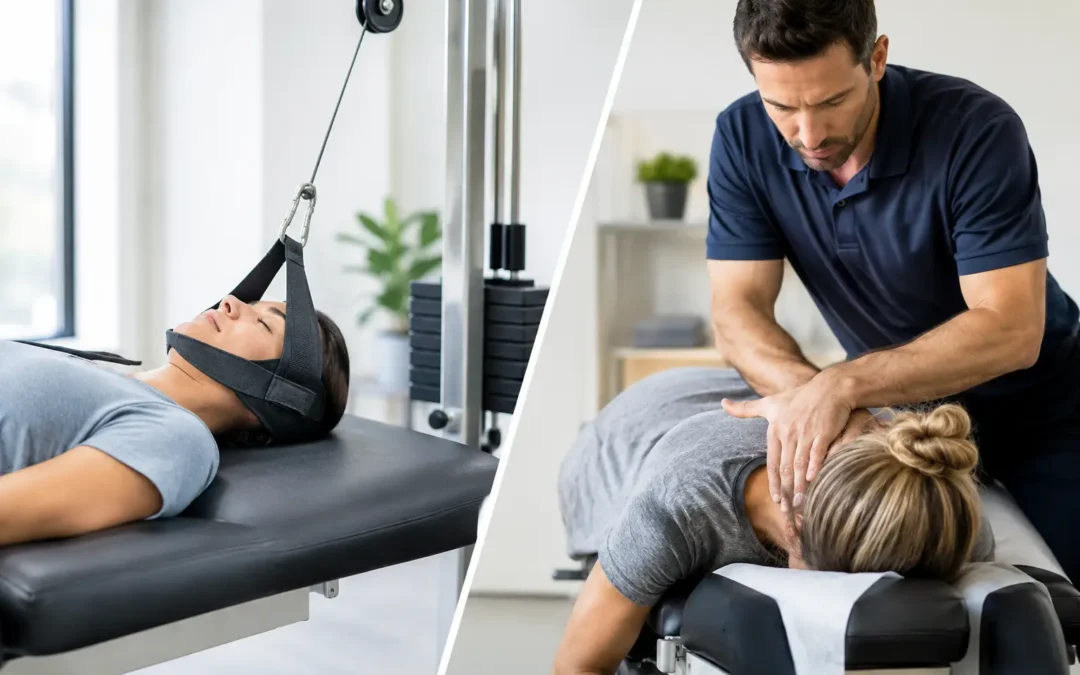
A stiff neck after a car crash, pain that travels into the arm or leg, or a back that locks up after sitting all day can make one question feel urgent: what treatment will actually help? When comparing traction versus spinal manipulation, the better choice is rarely a simple either-or answer. These treatments work differently, and the right plan depends on the source of pain, spinal motion, tissue irritation, posture, neurologic findings, and a patient’s ability to actively participate in rehabilitation.
For many people, the most productive approach is not choosing one treatment over the other. It is using the appropriate hands-on care at the right time, then supporting it with targeted exercises that help the body hold onto better movement patterns.
Traction Versus Spinal Manipulation: The Core Difference
Spinal traction is a controlled pulling or lengthening force applied to an area of the spine. Cervical traction focuses on the neck, while lumbar traction focuses on the low back. Depending on the patient’s needs, traction may be delivered manually, mechanically, or through a rehabilitative setup that places the spine in a specific position.
The purpose is not to “pull a disc back into place.” Rather, traction may be used to gently unload tissues, reduce compressive stress, improve tolerance for certain movements, and help restore a healthier spinal curve or posture when appropriate. It is commonly considered for patients whose symptoms may be aggravated by compression, sustained poor posture, disc involvement, or restricted motion.
Spinal manipulation, often called a chiropractic adjustment, is a precise, controlled force applied to a joint that is not moving normally. The goal is to improve joint motion and reduce mechanical restriction. An adjustment may also help decrease protective muscle guarding and make movement feel more comfortable for some patients.
In practical terms, traction creates a sustained or repeated decompressive force, while manipulation addresses joint mechanics through a brief, specific movement. They are different tools, not competing philosophies.
When Traction May Be Considered
Traction is often part of a broader rehabilitation plan for neck and back conditions where posture, disc health, and loading patterns need attention. A patient with forward-head posture and loss of the normal cervical curve, for example, may have difficulty maintaining a comfortable head and neck position through a full workday. Carefully prescribed cervical traction can be one component of restoring movement tolerance and postural endurance.
It may also be considered when a person has radiating symptoms, such as pain, tingling, or numbness traveling from the neck into the shoulder and arm, or from the low back into the leg. Those symptoms can occur when spinal structures and nearby nerves are irritated. Not every case of radiating pain is appropriate for traction, which is why a thorough examination matters.
After a whiplash injury, traction is not automatically the first step. In the early stage, the neck can be highly sensitive, and the treatment plan must account for pain level, range of motion, muscle guarding, headache symptoms, and the details of the collision. Once the patient can tolerate it, repetitive cervical traction may become part of a structured program aimed at improving posture and reducing the strain placed on injured tissues.
Traction should feel controlled and purposeful. Some patients experience a sense of relief during or after treatment; others may need adjustments to the position, force, duration, or frequency. A treatment that increases symptoms or leaves a patient significantly worse should be reassessed rather than pushed through.
When Spinal Manipulation May Be Considered
Spinal manipulation can be useful when examination identifies restricted joint movement contributing to pain, stiffness, or inefficient mechanics. A person who cannot comfortably turn their head after sleeping awkwardly, bend after lifting, or fully extend their back after long hours at a desk may have joint and muscular restrictions that respond well to a specific adjustment.
For accident-related injuries, adjustments may be introduced carefully and at a pace that matches the patient’s condition. Whiplash can affect more than the neck. It may alter shoulder mechanics, thoracic mobility, low-back function, balance, and muscle coordination. A skilled provider considers the whole pattern instead of repeatedly adjusting the most painful spot.
Manipulation is not meant to force the body into a correction. It is one part of care designed to improve motion so the patient can move, stretch, strengthen, and retrain more effectively afterward. This distinction matters. An adjustment may provide welcome short-term relief, but lasting improvement usually requires the muscles and nervous system to support better spinal mechanics between visits.
Why an Adjustment Alone May Not Be Enough
Pain relief is valuable, but it is not the same thing as rehabilitation. If a person returns immediately to the same slumped work posture, weak core control, limited neck endurance, or guarded movement pattern, the original strain on the spine may remain.
That is why active rehabilitation is central to corrective chiropractic care. Following an adjustment, patients may work on controlled stretching, core stabilization, postural exercises, balance work, and neuromuscular re-education. These activities help translate improved joint motion into useful daily function.
At NW Spinal Rehabilitation Clinic, care may include tools such as the Wobble Chair, repetitive cervical traction, strengthening, and post-adjustment rehabilitation based on the patient’s examination and goals. The patient’s role is essential. Consistent home exercise and participation in the office are what help improvements last longer than the treatment session itself.
How Providers Decide Between Them
A responsible recommendation starts with a clinical evaluation, not a one-size-fits-all protocol. The provider should consider where symptoms occur, what movements worsen or relieve them, how the injury happened, posture, spinal range of motion, muscle strength, reflexes, sensation, and whether there are signs that require medical referral or imaging.
A patient with acute, severe pain may first need a gentler approach focused on comfort and protected movement. Someone with chronic postural strain may tolerate a more active program from the beginning. A person recovering from a collision may need treatment that progresses gradually as pain decreases and stability improves.
Certain situations call for extra caution or a different type of care. New or worsening weakness, loss of bowel or bladder control, numbness in the groin area, fever with significant back pain, unexplained weight loss, suspected fracture, or severe unrelenting pain require prompt medical evaluation. Patients should also disclose osteoporosis, prior spinal surgery, inflammatory disease, blood-thinning medication, cancer history, and other relevant health conditions before treatment begins.
What a Combined Plan Can Look Like
For the right patient, traction and manipulation may be used in the same course of care, but not necessarily during every visit or in the same sequence. An adjustment may help restore motion in a restricted spinal segment. Traction may then be used to address tolerance to loading, posture, or compression-related symptoms. Rehabilitation exercises follow to build control and endurance.
The exact plan should change as the patient improves. Early care may emphasize reducing irritation and restoring basic motion. Later phases often place more attention on strength, posture, coordination, and safely returning to work, driving, exercise, or household responsibilities.
Progress should be measured by more than pain scores. Useful signs include greater range of motion, fewer headaches, improved ability to sleep, better tolerance for sitting or standing, less frequent radiating symptoms, and increased confidence with normal activities. If progress stalls, the plan should be reviewed rather than repeated without purpose.
The Question Is Not Which Treatment Wins
Traction versus spinal manipulation is best viewed as a clinical decision about what your spine needs now. Traction may be helpful when gentle unloading and postural correction are appropriate. Manipulation may be helpful when restricted joint motion is limiting function. Neither replaces the work of rebuilding strength, movement confidence, and healthier daily habits.
If neck or back pain is keeping you from working, sleeping, exercising, or feeling like yourself after an injury, seek an evaluation that looks beyond the painful area. The right plan should give you a clear role in recovery and practical steps toward moving with greater comfort and confidence.