
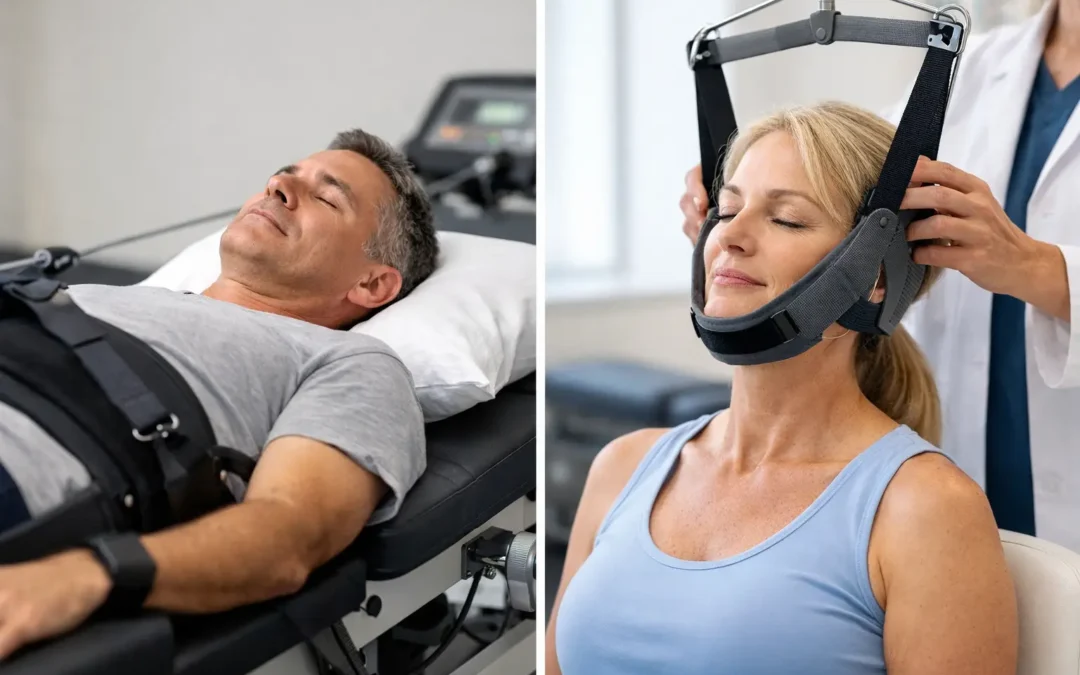
A traction surgery comparison is rarely as simple as choosing between a machine and an operating room. For someone living with neck pain after a car crash, sciatica from a disc injury, or persistent low-back pain that limits work and sleep, the real question is whether the spine can recover with appropriate conservative care or whether there is a problem that requires surgical intervention.
Traction and surgery serve very different purposes. One is a non-surgical rehabilitation tool used to address mechanical stress, restricted motion, muscular imbalance, and, in selected cases, symptoms related to disc irritation. The other may be necessary when a structural problem is causing progressive nerve damage, instability, or disabling symptoms that have not improved with a well-managed course of conservative treatment.
Traction Surgery Comparison: Different Tools, Different Goals
Spinal traction uses controlled pulling forces to gently separate spinal segments or guide the neck or lower back into a more favorable position. Depending on the area being treated and the patient’s condition, traction may be delivered mechanically, manually, or through a prescribed home-based program. Cervical traction is often used in rehabilitation plans for certain neck conditions, while lumbar traction may be considered for selected lower-back complaints.
The goal is not to “put a disc back in place.” Discs, joints, muscles, nerves, posture, and movement patterns all influence pain and function. Traction may help reduce mechanical loading, improve mobility, ease muscle guarding, and create a more comfortable setting for corrective exercise and neuromuscular rehabilitation. It is generally most useful as one part of a complete plan, not as a stand-alone answer.
Surgery has a different goal. Procedures such as discectomy, decompression, fusion, or disc replacement are intended to address specific anatomical problems. A surgeon may recommend an operation to remove pressure from a nerve root, stabilize an unstable spinal segment, or create more room in a narrowed spinal canal. Surgery can be life-changing for the right diagnosis, but it also involves anesthesia, recovery time, tissue healing, and procedure-specific risks.
Neither approach is automatically better. The appropriate path depends on symptoms, physical examination findings, imaging when needed, medical history, response to prior care, and the effect the condition is having on daily life.
When Traction and Active Rehabilitation May Be Considered
Many episodes of back and neck pain improve without surgery. This includes a number of cases involving postural strain, whiplash-associated dysfunction, muscle spasm, reduced spinal curves, joint restriction, and some disc-related symptoms without severe neurologic compromise.
For these patients, traction may be included alongside chiropractic adjustments, targeted stretching, core strengthening, posture correction, and progressive movement training. At NW Spinal Rehabilitation Clinic, the focus is on active participation. A visit may include preparation with movements such as Wobble Chair work, corrective traction when appropriate, adjustments, and post-adjustment exercises designed to help the body hold and use improved movement patterns.
That active component matters. Pain can cause people to guard, move less, and adopt compensations that spread stress to other areas. A treatment that temporarily reduces symptoms without rebuilding mobility, strength, and postural control may not provide the lasting change a patient needs. Rehabilitation gives the patient a role in recovery through specific exercises and at-home participation.
Traction is not appropriate for everyone, and it should not be applied based on an MRI report alone. A disc bulge is common, including in people who do not have pain. What matters is the relationship among imaging findings, symptoms, neurological examination, and function. The same image can mean very different things for two different people.
When Surgery May Be the Better Choice
There are situations in which delaying surgical evaluation is not wise. Progressive weakness in an arm or leg, worsening loss of coordination, significant bowel or bladder changes, numbness in the saddle area, or symptoms suggesting spinal cord involvement require urgent medical assessment. These symptoms are not situations to self-treat with traction or exercise.
Surgery may also be considered when a patient has persistent, severe nerve pain with clear imaging and examination findings that match a surgically correctable problem, especially after a sufficient trial of conservative care has not produced meaningful improvement. For example, a large disc herniation causing persistent leg pain, weakness, and loss of function may warrant consultation with a spine surgeon.
In the cervical spine, significant cord compression can be particularly serious. Symptoms may include increasing hand clumsiness, balance difficulty, altered gait, weakness, or changes in fine motor control. Not every neck problem involves the spinal cord, but possible cord symptoms deserve prompt attention.
A surgical recommendation should be based on more than pain intensity. Pain is real and can be debilitating, yet surgery is most predictable when there is a clear target that matches the person’s symptoms and examination. A thoughtful consultation should explain what the procedure is intended to improve, what it may not change, the alternatives, and the expected recovery process.
The Trade-Offs Patients Should Understand
Non-surgical care usually allows patients to remain active in daily life while working through a structured plan. It avoids surgical risks and can address contributing factors such as deconditioning, posture, restricted movement, and poor lifting mechanics. The trade-off is that recovery may take time and consistency. Relief may be gradual, and some conditions will not respond enough to conservative treatment.
Surgery can provide faster relief when nerve compression or instability is the primary driver of symptoms. It may prevent further neurological decline in situations where that is a risk. However, surgery is still a major medical decision. Recovery can involve temporary restrictions, medication, physical therapy, time away from work, and the possibility that some symptoms persist. A successful procedure may relieve pressure on a nerve, but it does not automatically restore conditioning, movement confidence, or the habits that protect the spine over time.
Fusion procedures deserve especially careful discussion because they intentionally limit motion at one or more spinal levels. That stability can be necessary, but it may also change how forces are distributed through adjacent segments. The right decision depends on the reason for the fusion, the patient’s anatomy, lifestyle, bone health, and treatment goals.
Questions That Lead to Better Decisions
Patients often feel pressured to choose quickly after hearing words such as herniation, stenosis, degeneration, or nerve compression. A better approach is to make sure the diagnosis explains the actual problem. Ask whether the examination findings match the MRI or CT results, whether there are objective signs of nerve loss, and what improvement is realistic with conservative care.
It is also reasonable to ask how long a non-surgical trial should last, what would indicate that it is not working, and which symptoms should prompt urgent reevaluation. If surgery is suggested, ask what specific structure is being treated, what happens if you wait, and whether a second surgical opinion would be useful. Good clinical decision-making is not about avoiding surgery at all costs or rushing toward it. It is about choosing the least invasive option that responsibly addresses the condition.
For car-crash injuries, timing and documentation can add another layer. Whiplash can involve soft-tissue injury, joint dysfunction, disc irritation, headaches, dizziness, and altered movement long before the full pattern is clear. A detailed examination and a rehabilitation plan that progresses with the patient’s tolerance can help distinguish recoverable dysfunction from signs that need medical or surgical evaluation.
Recovery Should Remain the Focus
The best traction surgery comparison recognizes that these options may not always be opposites. Some people benefit from conservative rehabilitation and never need surgery. Others need surgery first, then require careful rehabilitation to restore strength, mobility, posture, and confidence in movement. The right plan is the one that respects warning signs, uses objective findings, and gives your body the best opportunity to regain function safely.
If back or neck pain is changing how you work, sleep, drive, or care for your family, seek an evaluation that looks beyond a single image or a single treatment. A clear diagnosis and an active recovery plan can make the next step feel far less uncertain.