
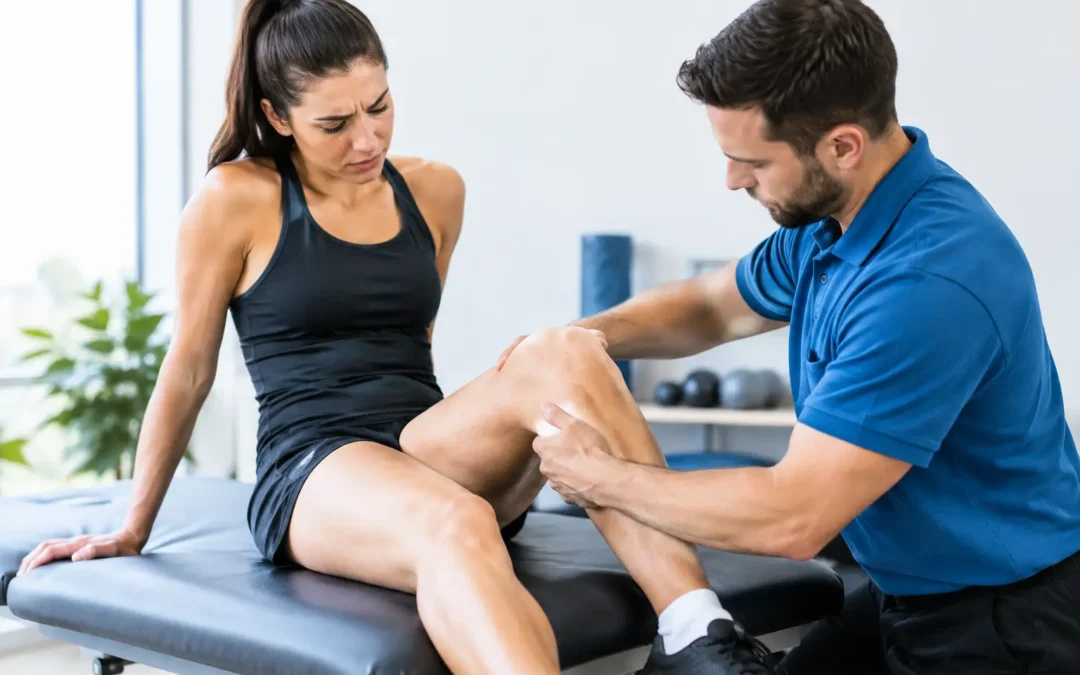
A runner feels a sharp pull in the back of the thigh during a hill repeat. A recreational basketball player lands awkwardly and develops knee pain. A weekend golfer wakes up with neck stiffness that makes it hard to turn toward traffic. Sports injuries rarely arrive at a convenient time, and the first decision – whether to push through, rest, or seek care – can influence how fully someone recovers.
Pain is a signal, not always a diagnosis. Some soreness after a new workout is normal. Pain that changes the way you walk, throw, lift, rotate, or sleep deserves more attention. For active adults, a meaningful recovery is not simply getting pain low enough to return to the activity. It is restoring the mobility, strength, coordination, and spinal support needed to participate with greater confidence.
Why Sports Injuries Are Often More Than Local Pain
An injury may be felt in one location while involving a larger movement problem. For example, ankle instability can change walking and running mechanics, placing additional stress on the knee, hip, and low back. A shoulder problem may be connected to restricted motion in the upper back, poor posture, or altered neck mechanics. Low back pain during deadlifts may reflect more than a sore muscle if the hips, core, and spinal control are not sharing the load effectively.
This does not mean every ache comes from the spine. It does mean that isolated treatment can miss the reason an area keeps becoming overloaded. The body moves as a connected system. When one part loses motion, stability, or endurance, another part often compensates.
That compensation can be subtle at first. An athlete may shorten a stride, avoid full rotation, shrug the shoulder during overhead movements, or shift weight away from one leg. These changes may allow activity to continue temporarily, but they can also reinforce faulty movement patterns. Over time, the original injury may become a recurring problem or contribute to pain elsewhere.
A thorough evaluation looks beyond the painful spot. It considers how the injury happened, what movements reproduce symptoms, whether range of motion has changed, and how posture, balance, and muscle control may be affecting recovery. This broader view is especially useful for people who have had repeated strains, persistent stiffness, or pain that returns as soon as they resume training.
When Rest Is Helpful and When It Is Not Enough
Rest has a role after an acute injury. Reducing aggravating activity can protect irritated tissues and give the body time to settle. But prolonged rest alone can also lead to stiffness, loss of conditioning, reduced confidence, and weaker movement control. The right amount of rest depends on the injury, its severity, the person’s health history, and the demands of the sport or activity.
A minor muscle soreness that improves steadily over several days may respond well to modified activity, gentle mobility work, and a gradual return to training. A more significant injury needs a more deliberate plan. Swelling, bruising, joint instability, sharp pain, numbness, weakness, loss of motion, or pain that is not improving are reasons to be evaluated rather than trying to train through it.
Certain symptoms require prompt medical attention. Seek urgent care for obvious deformity, inability to bear weight after an injury, severe or escalating headache after a hit to the head, confusion, fainting, chest pain, new bowel or bladder changes, or progressive weakness. If a concussion is suspected, do not return to play the same day. These situations should be assessed by the appropriate medical professional before rehabilitation begins.
For non-emergency musculoskeletal injuries, the goal is usually not complete inactivity. It is finding safe movement that maintains circulation, preserves function, and avoids repeatedly provoking the injured area. That may mean walking instead of running for a period, reducing lifting load, avoiding painful end ranges, or choosing controlled rehabilitation exercises over full-speed practice.
Sports Injury Rehabilitation Should Rebuild Function
A return-to-activity plan should answer more than, “Does it hurt today?” It should also ask whether the body can tolerate the movements required tomorrow. Someone may be able to jog without pain but still lack the hip control needed for cutting in soccer. A person may have no pain while lifting light weight but still lack the spinal endurance necessary for a long workday followed by a workout.
Effective rehabilitation progresses from symptom control toward movement restoration and conditioning. In the early phase, care may focus on reducing irritation, improving restricted motion, and helping the patient move more comfortably. As symptoms improve, the emphasis should shift toward strength, flexibility, balance, coordination, and sport-specific demands.
At NW Spinal Rehabilitation Clinic, this active approach may include chiropractic adjustments when clinically appropriate, stretching, traction, postural rehabilitation, core work, and neuromuscular exercises. The purpose is not to chase a temporary feeling of relief. It is to help restore the spinal and muscular support that allows the body to move more efficiently over time.
For a patient with neck pain after cycling, for instance, treatment may address cervical mobility and posture while also improving the endurance of muscles that support the head and upper back. For low back pain related to recreational lifting, the plan may include spinal mobility, hip movement, core stabilization, and instruction on returning to loading gradually. The details should be individualized. A tennis player’s shoulder needs are different from a runner’s hip needs, even when both have symptoms connected to poor postural control.
Active Participation Changes the Recovery Process
Hands-on care can be valuable, but durable improvement usually requires participation outside the treatment room. Rehabilitative exercises help retrain the body to hold and use the changes gained during care. This is why an active program may include home stretching, specific strengthening work, posture drills, or prescribed traction protocols.
Consistency matters more than intensity in the beginning. Doing the right exercise with good form several times a week is generally more helpful than attempting a demanding workout once, flaring symptoms, and needing to stop again. Progression should be based on response. Mild muscular fatigue can be expected; sharp pain, increasing numbness, swelling, or symptoms that remain worse afterward are signs that the plan may need adjustment.
Returning to Sport Without Rushing the Finish Line
The pressure to return can be strong. Adults often want to get back to a league, a fitness class, a race plan, or the physical demands of work. But returning too quickly can turn a manageable injury into a longer interruption. A safer return is gradual and specific to the activity.
Before resuming full participation, consider whether you can move through the required range of motion without significant pain or compensation. Can you squat, rotate, reach, land, or change direction with control? Can you complete a practice-level workload without symptoms building later that day or the following morning? These practical measures are often more meaningful than simply checking whether pain is absent while resting.
Load should rise in manageable steps. A runner may begin with shorter, flatter routes before adding speed or hills. A weightlifter may rebuild technique and volume before testing prior maximum loads. A pickleball player may practice controlled serves and lateral movement before playing several competitive games. There is no universal timeline because tissue healing, fitness level, prior injury history, sleep, work demands, and the nature of the sport all matter.
Recovery also benefits from the basics: adequate sleep, regular meals with sufficient protein, hydration, and realistic training volume. These are not replacements for clinical care when an injury requires it, but they affect how well the body adapts to rehabilitation and exercise.
Prevention Is Better Framed as Preparation
No program can prevent every injury. Falls, collisions, unpredictable terrain, and simple bad luck are part of active life. Still, many recurring sports injuries are influenced by modifiable factors such as poor movement mechanics, sudden spikes in training volume, limited mobility, inadequate recovery, and reduced strength or balance.
Preparation should match the activity. Runners benefit from progressive mileage and lower-body control. Overhead athletes need shoulder stability and upper-back mobility. Golfers and tennis players need rotational capacity without forcing motion through the low back. Desk workers who exercise after work may need to address the postural strain accumulated during the day, not only what happens during the workout.
The most useful plan is one a person can continue. A brief, targeted routine performed consistently often does more for resilience than an elaborate program that never becomes part of real life. If pain keeps returning, changes your activity, or leaves you uncertain about what is safe, a structured evaluation can replace guesswork with a recovery plan built for your body and your goals.