
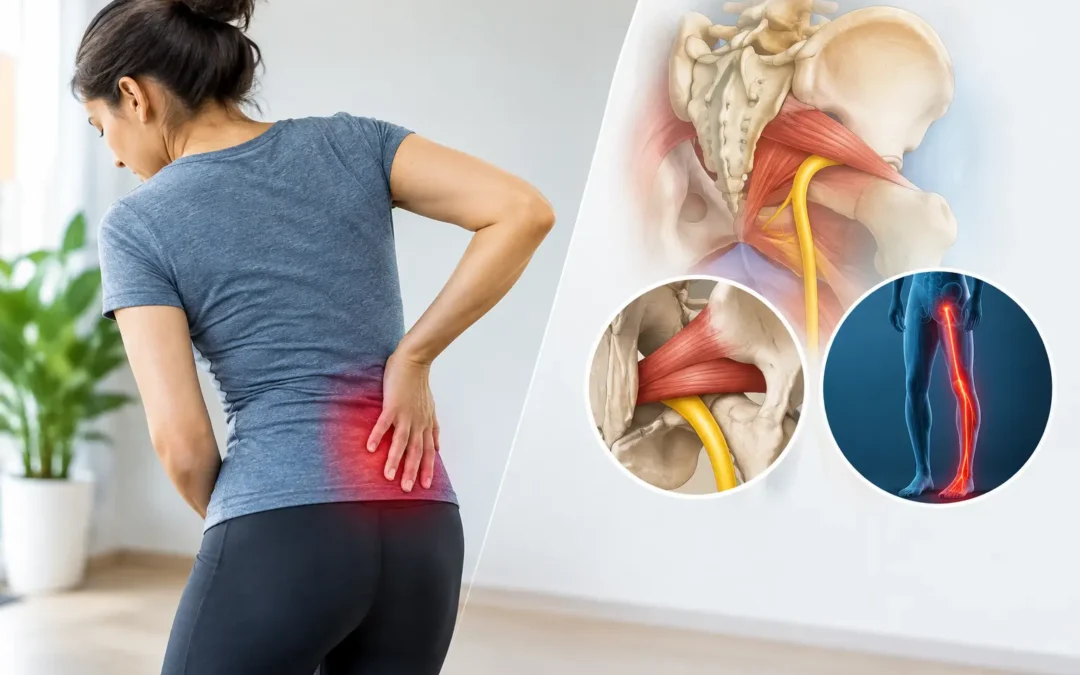
A sharp ache that starts in the low back or buttock and travels down the leg can make ordinary tasks feel uncertain. Sitting through a commute, getting out of a car, climbing stairs, or bending to pick something up may suddenly become a painful calculation. When comparing sciatica versus piriformis syndrome, the symptoms can overlap enough that self-diagnosis is often misleading. The location of pain matters, but so do the movements that provoke it, the history behind it, and the way the spine, pelvis, and muscles are functioning together.
Sciatica Versus Piriformis Syndrome: The Core Difference
Sciatica is not a diagnosis by itself. It is a term for symptoms caused by irritation, inflammation, compression, or injury affecting the sciatic nerve or one of the nerve roots that contributes to it. The sciatic nerve begins in the lower spine, travels through the pelvis and buttock, and runs down the back of each leg.
Most commonly, true sciatic symptoms begin when a nerve root in the lumbar spine is irritated. A disc bulge or herniation, narrowing around the nerve, degenerative changes, spinal instability, or trauma can all contribute. A car crash, for example, can create forces that strain spinal tissues and alter movement patterns, even when initial imaging does not tell the whole story.
Piriformis syndrome is different. The piriformis is a small, deep muscle in the buttock that helps rotate and stabilize the hip. The sciatic nerve passes beneath this muscle in most people, although its exact route varies. If the piriformis becomes tight, irritated, overworked, or affected by nearby pelvic dysfunction, it may place pressure on or aggravate the sciatic nerve.
In simple terms, sciatica often points to a problem involving the lower spine or nerve roots. Piriformis syndrome points to irritation of the sciatic nerve farther along its path in the buttock. However, the body does not always follow simple categories. A person can have lumbar disc irritation and piriformis muscle guarding at the same time.
How the Symptoms May Feel Different
Both conditions can produce buttock pain, tingling, numbness, burning, or pain that extends into the thigh or lower leg. This is why a careful examination is more useful than choosing a diagnosis based on one symptom alone.
Signs that may suggest lumbar-related sciatica
Sciatica caused by the lumbar spine often includes low back pain along with leg symptoms. The discomfort may travel below the knee and sometimes reach the foot or toes. Coughing, sneezing, bending forward, prolonged sitting, or lifting can increase symptoms because these actions may stress the lower back or increase pressure around an irritated nerve.
Some people also notice weakness, such as difficulty lifting the front of the foot, pushing off while walking, rising onto the toes, or maintaining balance on one leg. Numbness may follow a recognizable pattern down one side of the leg. These findings do not automatically mean surgery is necessary, but they do make a thorough evaluation especially important.
Signs that may suggest piriformis involvement
Piriformis syndrome often produces deeper buttock pain that may feel centered near one side of the hip. Sitting, driving, crossing the legs, climbing hills, running, or rotating the hip can be particularly provocative. The pain may radiate down the back of the thigh, but it is sometimes less likely to extend all the way into the foot than lumbar nerve-root irritation.
Tenderness or tightness in the buttock can be part of the pattern. Some people feel better when standing or walking briefly, then notice symptoms return after extended sitting. Still, these clues are not definitive. Hip joint conditions, sacroiliac dysfunction, hamstring injuries, and lumbar disc problems can create similar complaints.
Why a Correct Assessment Changes Care
Treating every case of leg pain as a tight piriformis can delay care for a disc injury or nerve-root problem. On the other hand, focusing only on the lumbar spine may miss hip and pelvic mechanics that keep the buttock muscles in a cycle of guarding and irritation.
A useful clinical assessment looks beyond where the pain is felt. It should consider posture, spinal curves, range of motion, walking patterns, hip mobility, muscle strength, reflexes, sensation, and how symptoms respond to specific movements. A provider may use nerve tension testing, orthopedic testing, and functional movement assessment to identify whether symptoms are more consistent with nerve-root involvement, local muscular irritation, or a combination of both.
This distinction is particularly relevant after a collision. People often focus on neck pain after whiplash, but lower-back, pelvic, and hip injuries can develop or become more noticeable in the days that follow. Protective muscle tension may initially hide the full extent of dysfunction. As activity resumes, buttock pain, leg tingling, and restricted movement can become harder to ignore.
What Non-Surgical Rehabilitation May Include
The best approach depends on the source of symptoms, the severity of nerve involvement, and the patient’s daily demands. A treatment plan should not be limited to temporary relief. The goal is to reduce irritation while improving the movement and structural factors that may be contributing to it.
For lumbar-related sciatica, care may focus on improving spinal motion, reducing stress on irritated tissues, restoring postural support, and progressively rebuilding core control. Depending on the examination, this can include specific chiropractic adjustments, traction, guided stretching, and rehabilitative exercises designed to improve tolerance for sitting, bending, lifting, and walking.
When piriformis involvement is present, the plan may also address hip mobility, pelvic control, gluteal strength, and the habitual movement patterns that overload the deep buttock muscles. Aggressive stretching is not always the answer. If a nerve is highly irritated, forcing a stretch can increase symptoms. Controlled mobility work, gradual strengthening, and changes to sitting or activity habits may be more appropriate early on.
At NW Spinal Rehabilitation Clinic, active participation is part of the care process. Corrective rehabilitation can combine adjustments with traction, stretching, core exercises, and post-adjustment neuromuscular work. The purpose is not simply to feel better for a day or two. It is to help the spine and supporting muscles function more effectively so everyday movement becomes more sustainable.
What You Can Do While Seeking Care
Avoid testing your limits repeatedly just to see whether the pain is gone. Long drives, slouched sitting, heavy lifting, sudden twisting, and prolonged bed rest can all aggravate symptoms for different reasons. Gentle movement is usually preferable to complete inactivity, but the right amount depends on the condition.
Pay attention to patterns. Does pain worsen with sitting, bending, walking, coughing, hip rotation, or standing in one position? Does it travel below the knee? Are you noticing numbness, weakness, or changes in balance? These details help guide an accurate evaluation and allow treatment to be tailored to your presentation rather than a generic label.
Use caution with online exercise routines. A movement that helps one person with piriformis-related pain may aggravate someone with a disc-related nerve problem. Similarly, applying pressure directly to a tender buttock muscle can feel relieving for some people but worsen symptoms in others when the nerve is already sensitive.
When Leg Pain Needs Urgent Attention
Most cases of sciatica or piriformis-related pain can be assessed through a scheduled clinical visit, but certain symptoms require prompt medical attention. Seek urgent evaluation for new loss of bowel or bladder control, numbness in the groin or saddle area, rapidly worsening leg weakness, severe pain following a significant injury, fever with back pain, or unexplained weight loss.
Persistent numbness, progressive weakness, or symptoms that are interfering with sleep, work, or walking also deserve a timely examination. Waiting for pain to become unbearable rarely improves the recovery process.
The most productive next step is not to decide on your own whether the pain is sciatica or piriformis syndrome. It is to have the spine, hips, nerves, and movement patterns evaluated together. With a clear picture of what is driving the symptoms, rehabilitation can move beyond chasing pain and toward restoring the confidence to sit, walk, work, and move without constant fear of the next flare-up.