
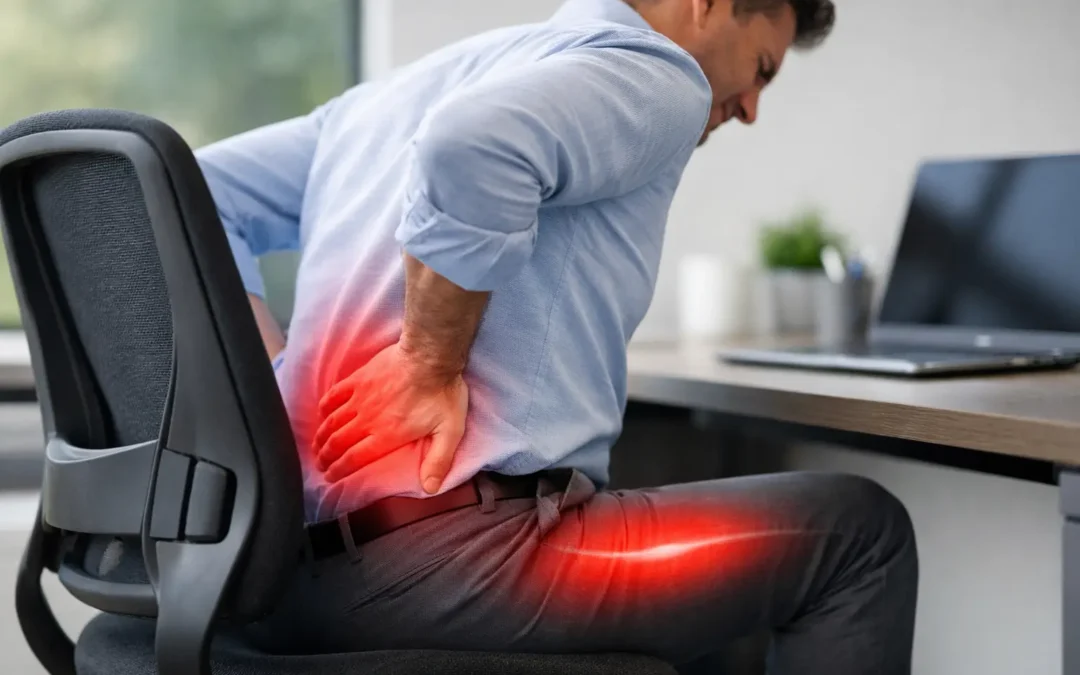
A commute, a desk shift, or even a quiet dinner can become difficult when pain starts in the low back and travels into the buttock, thigh, calf, or foot. If you have wondered, why does sciatica worsen sitting, the answer is often more involved than “a pinched nerve.” Sitting changes the position and loading of the lumbar spine, hips, discs, and supporting muscles. When an irritated nerve is already sensitive, those changes may be enough to bring on burning, tingling, numbness, or sharp leg pain.
Sciatica is a symptom pattern, not a diagnosis by itself. The sciatic nerve and the nerve roots that contribute to it can become irritated for different reasons, including a disc bulge or herniation, spinal joint dysfunction, narrowing around the nerve, muscle tension, or injury-related changes in spinal mechanics. Finding the source matters because the position that aggravates one person can relieve another.
Why Does Sciatica Worsen Sitting?
For many people, sitting places the low back in a flexed, or rounded-forward, position. This is especially true when the chair is low, soft, reclined, or poorly supportive. As the pelvis rolls backward, the normal inward curve of the lumbar spine can flatten. The tissues of the low back must then manage load in a less favorable position.
In a healthy spine, the discs between the vertebrae help distribute pressure and allow movement. When a disc is irritated or injured, prolonged flexion may aggravate symptoms in some patients. The disc and nearby structures can become more sensitive, and an already irritated nerve root may have less tolerance for compression, chemical inflammation, or repeated stretch. That is why someone may feel relatively manageable when standing, then develop leg symptoms after 15 minutes in a car or at a computer.
Sitting also removes much of the natural movement that helps muscles share the work of supporting the spine. The hip flexors remain shortened, the deep abdominal and back stabilizers may become less active, and the gluteal muscles are not contributing as they do during walking. Over time, fatigue can lead to slumping, shifting to one side, crossing the legs, or leaning toward an armrest. Each compensation can alter pressure through the pelvis and low back.
The car seat can be a common trigger
Car travel frequently worsens sciatica because it combines several challenges: a semi-reclined posture, vibration, limited ability to change position, and prolonged hip flexion. After a collision, these symptoms may be even more noticeable if the spine, discs, muscles, or ligaments were affected by the trauma.
A driver may also repeatedly rotate or reach with one arm, keep one foot on the pedals, and remain in the same position through traffic. None of these movements is necessarily harmful on its own. But in a sensitized system, the accumulated load can turn a short trip into a painful one.
Sitting Does Not Aggravate Every Type of Sciatica
“Sciatica” is often used to describe any pain down the leg, but the underlying cause changes the pattern. A disc-related problem may be more sensitive to sustained bending and sitting. In contrast, some people with spinal stenosis, a condition involving narrowing around spinal nerves, may feel worse standing or walking and somewhat better when sitting or bending forward.
Piriformis-related symptoms, hip dysfunction, and deep gluteal muscle irritation can also create pain that feels like sciatica. In these cases, direct pressure from a seat, long periods with the hip flexed, or sitting on a wallet in a back pocket may be particularly aggravating. This is one reason a careful examination is more useful than assuming every radiating leg symptom has the same cause.
The location and behavior of your symptoms provide useful clues. Pain that centralizes, or moves out of the leg and closer to the low back, can be a favorable change in some disc-related cases. Pain that progressively travels farther down the leg, becomes more numb, or appears with weakness deserves professional attention.
Why Slouching and Poor Support Matter
A chair does not need to be visibly uncomfortable to encourage a poor spinal position. Deep couches and soft office chairs often allow the pelvis to sink backward. Laptop work can pull the head and shoulders forward, increasing strain through the entire spinal chain. If the low back has lost some of its normal curve due to prolonged posture habits, injury, or muscle imbalance, the body may have fewer comfortable options for maintaining an upright seated position.
This does not mean you need to sit perfectly still with an exaggerated arch in your back. Overcorrecting can create tension too. The goal is a supported, neutral working position that allows the spine to retain a comfortable curve while the feet rest securely and the hips are not excessively flexed.
A small lumbar support may help some people tolerate sitting, particularly in the car. Adjusting the seat so the hips are level with or slightly higher than the knees can also reduce the tendency to slump. These changes are useful tools, but they are not a substitute for identifying why the nerve is irritated in the first place.
What to Do When Sitting Brings on Leg Pain
The most helpful first step is often to reduce uninterrupted sitting rather than avoiding all sitting. Set a realistic movement interval. For some people, standing and walking briefly every 20 to 30 minutes is appropriate; for others, symptoms may require more frequent changes. The goal is not to push through increasing leg pain. It is to give the spine and nervous system regular opportunities to unload and move.
Pay attention to what happens when you stand. If a brief walk reduces leg symptoms, that pattern is worth noting. If leaning forward, arching backward, or lying down changes the symptoms, record that as well. These details can guide a clinical examination and help distinguish between different mechanical patterns.
At home or at work, consider the basics of your setup: use a chair with a firmer seat, keep both feet supported, avoid sitting on bulky objects in your back pocket, and position your screen high enough that you are not constantly folding forward. For longer drives, plan breaks when possible and use the seat adjustments rather than accepting a slouched position.
Exercise can be valuable, but the right exercise depends on the cause and irritability of your symptoms. Generic stretching is not always the answer. Aggressive hamstring stretching or forceful nerve stretching can aggravate an already sensitive nerve in some cases. A structured rehabilitation plan may include carefully selected mobility work, core stabilization, hip and gluteal strengthening, spinal traction when clinically appropriate, and postural retraining.
When an Examination Is Needed
Persistent sciatica should not be treated as something you simply have to endure at your desk. A thorough assessment considers spinal alignment, disc and nerve signs, posture, movement tolerance, muscle control, reflexes, strength, and the effect of previous injuries. This is especially relevant after a car crash, when symptoms may not fully appear until days or weeks after the initial trauma.
At NW Spinal Rehabilitation Clinic, care is designed around more than a brief adjustment. When appropriate, chiropractic treatment is combined with active spinal and postural rehabilitation, stretching, strengthening, traction, and at-home participation to address the movement habits and muscular support that can keep symptoms recurring. The plan should fit the findings of the examination, your daily demands, and your ability to participate consistently.
Seek urgent medical evaluation if leg pain occurs with new or worsening weakness, loss of bladder or bowel control, numbness in the groin or saddle area, fever, unexplained weight loss, or severe symptoms following significant trauma. These signs require prompt assessment.
Sciatica that worsens while sitting is your body’s signal that a particular position or load is exceeding its current tolerance. Small changes in how often and how you sit may offer relief, but lasting progress usually comes from understanding the source of irritation and rebuilding the spinal support, movement, and confidence that daily life requires.